Matis Indians Photo Gallery
The Jaguar People
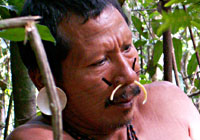
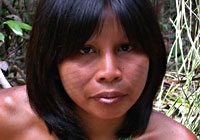
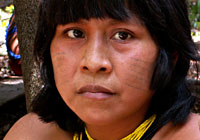
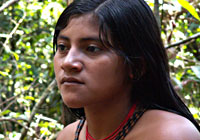
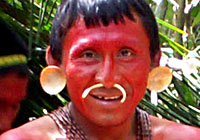
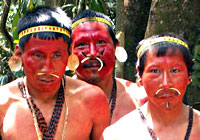
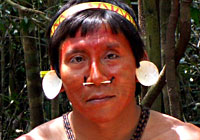
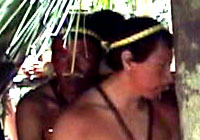
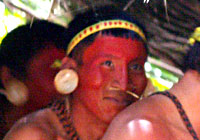
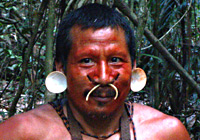
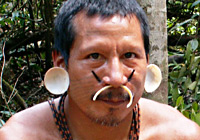
The Matis Indians (not
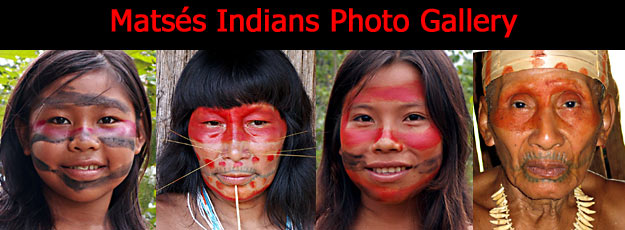
to be mixed up with the neighboring Matsés Indians) are a small band of panoan-speaking
native Amazonians who live in the Javari (Yavarí) Valley on the Itui River in
Brazil not far from the border with Peru. Only about 300 of them have survived
to the present date, the majority disappearing in the early 1980's, sacrificed
to the consequences of their first encounters with modern civilization and the
various disease epidemics that followed. However, recently the population of
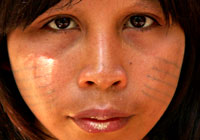
the Matis people has been increasing and their traditional cultural practices
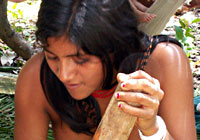
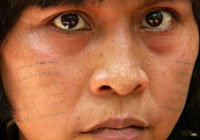
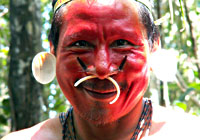
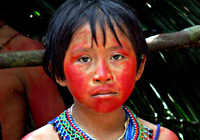
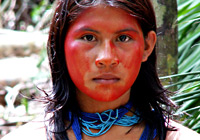
are experiencing a revival, an example being the facial tattooing of youths upon
reaching adulthood.
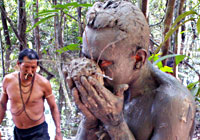
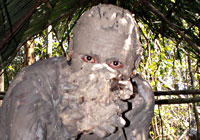
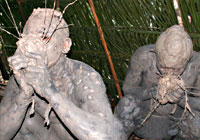
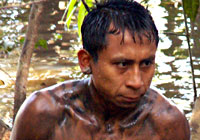
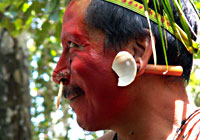
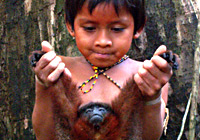
This photo gallery of these indigenous people of the Amazon Rainforest as
presented on these web pages is the result of an expedition that I sponsored and
funded. Collectively, these photographs document many important aspects of
their Amazonian culture, including important ceremonies, the making of ceramics, and
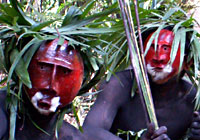
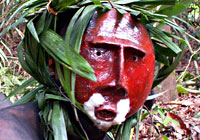
blowgun hunting. Three ceremonies are shown: Mariwin, Capybara, and Queixada.
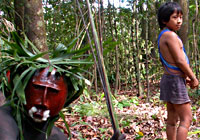
The Mariwin ceremony involves masked "ancestral spirits" who arrive (to the
dismay of Matis children) with whips, while the Capybara and Queixada ceremonies
involve "imitations" of animals which are important to their culture for hunting
and religious aspects. The Matis Indians have not been converted to
Christianity and still practice an animistic religion, with animal spirits being
of principle importance in their cosmological system. Simple said, the Matis
are a very superstitious people and believe that animal spirits are responsible
for health or illness, bountiful harvests versus famines, and having good
fortune in contrast to bad luck. In their world view, animal spirits must not
be offended or they could become sick, have crop failures or be ill-fated. If
offended, animal spirits can be manipulated with plants (often called by the
same name as the animal) whose extracts are normally applied externally or in
the eyes (an example being bëcchëte).
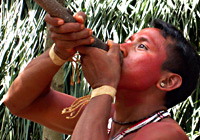
In contrast to most other tribes in the region (e.g. the Matsés and
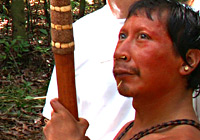
Marubos Indian Tribes) who no longer use blowguns (blowpipes), the Matis tribe still uses
precision four-meter blowguns. Matis blowguns are beautiful works of art in
addition to being precision instruments. The Matis typically decorate their
blowguns with mosaics made from pieces of tortoise eggshells, resulting in
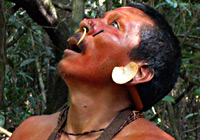
beautiful and functional instruments. Blowgun darts are tipped with curare
poison which paralyzes the prey. These indigenous people of the Amazon have
developed very impressive technology for blowgun hunting and are capable of
taking game at distances of up to 50 meters. Their technology is different than
the Korubo Indians in that Matis darts are smaller and use two pieces of
"cotton" rather than one. Curiously, the blowgun without the mosaic decorations
illustrated in the photos above is of Korubo origin rather than Matis. I have
documented many aspects of Matis blowgun technology in various
documentary films.
Presently, the greatest dangers to the survival of the Matis natives are two
foreign diseases: hepatitis and malaria which are the most important causes of
mortality in their communities. Consequently, I personally funded the
installation of a water wells for a native communities in the Javari (Yavarí) River Valley.
This health project that is installing water wells in indigenous villages in the
Javari Valley will aid in eliminating the risk of some types of hepatitis (i.e.
hepatitis A). In addition, I am working with the Peruvian Ministry of Health in
their ASIS program to conduct a survey in the Javari Valley in
order to establish to what extent hepatitis and malaria are present in
indigenous communities. This is the first step in establishing an effective
health program in that first you need to identify which diseases are important
in order to combat them.
Unlike some other Amazonian
natives, the Matis are remarkably friendly and helpful. Once when we were
searching at night together for frogs (to be used in their poison frog
ceremony), I remember how carefully they guided me and took care of me in this
dangerous situation, and believe me that being in the Amazon Rainforest at
night, crossing creeks via logs, and avoiding poisonous snake is indeed a
dangerous environment for both natives and non-natives alike. Over the years I
have developed a great respect for my Matis friends and have been amazed by
their survival skills in the Amazon jungle. Therefore, I would like to share
some of my experiences with you via this photo gallery and hope that you too
will appreciate their culture and that you will be culturally sensitive and help
to preserve indigenous cultures such as that of the Matis people.
If you would like to discover more about Amazonian Indian tribes, please become
a member so you can gain access to the
Member's Area.
This exclusive area is divided into six different sections: videos, maps,
dictionaries, books, magazines, and Brasil Indigena. In this
Member's Area you will encounter a "gold mine" of valuable information about
Amazonian natives. This information has been chosen so that you can use
these material to help plan your expedition to the Amazon jungle and meet real
indigenous tribes rather than just visiting an expensive tourist trap. If you like
my images of Amazon Indians, you can view more of them on this website, in addition to viewing
original
documentary films of my expeditions to the Matis Indians that are available
on DVD and Instant Download. By purchasing a documentary you
instantly become a member of Amazon-Indians.org and receive a password to enter
the Member's Area.
The author, Dr. Dan James Pantone, is the editor
of Amazon-Indians.org
and the founder of the Movement in the Amazon for Tribal Subsistence and Economic Sustainability, a nonprofit
association that is assisting native people in the Amazon Rainforest so that they
can preserve their culture and lands in a sustainable and independent manner.
Dan
James Pantone, Ph.D. arranged and led this expedition.
For more info, contact Dr. Pantone at
djpantone(at)amazon-indians.org
.
|